Black ice is dangerous precisely because it may not look like ice. The National Weather Service describes it as patchy roadway ice that is difficult to see, often clear enough for the dark pavement to show through. For a commercial vehicle, the right response begins long before the tires reach it: plan carefully, read the conditions, slow down early, and be willing to stop operating when the surface is icy.
Why black ice hides in plain sight
Black ice is not actually black. It is a thin, mostly transparent layer of ice that allows the dark pavement below to show through. It can form when rain, melted snow, fog, road spray, or ordinary roadway moisture freezes on the surface. Early morning is a common risk window after pavement temperatures fall overnight, but black ice can develop any time moisture meets a freezing surface.
Bridges and overpasses often freeze before the rest of the road because cold air reaches both the top and underside of the deck. Shade also matters. Pavement under trees, buildings, hills, and bridge structures can remain colder long after nearby sunlit lanes begin to thaw. Low areas can collect cold air and moisture. Freezing fog can coat pavement even without obvious precipitation, and runoff can refreeze after the main travel lanes appear clear.
A tractor-trailer adds mass, length, multiple axles, and a trailer that can keep moving when the tractor loses traction. A loss of grip that is manageable at a lower speed can become a drive-wheel skid, trailer swing, lane departure, or jackknife when speed, steering input, grade, or braking force is too high for the available traction.
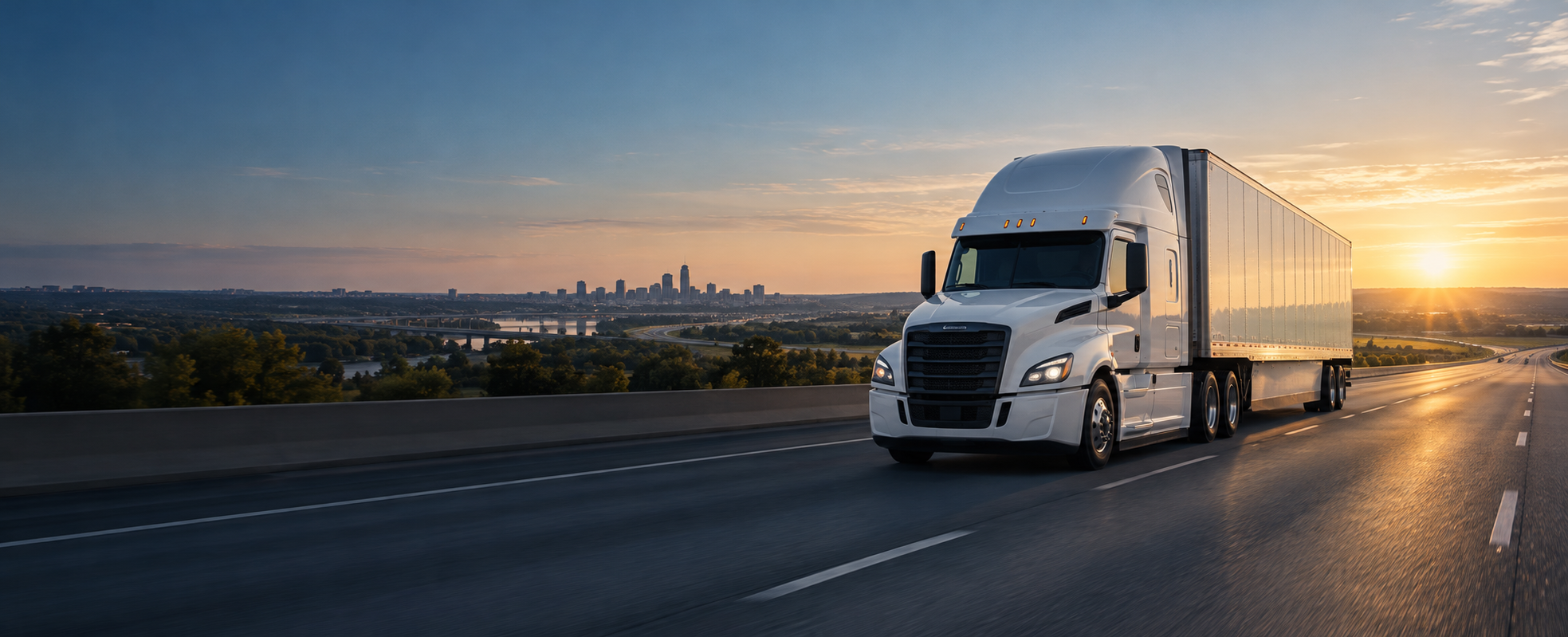
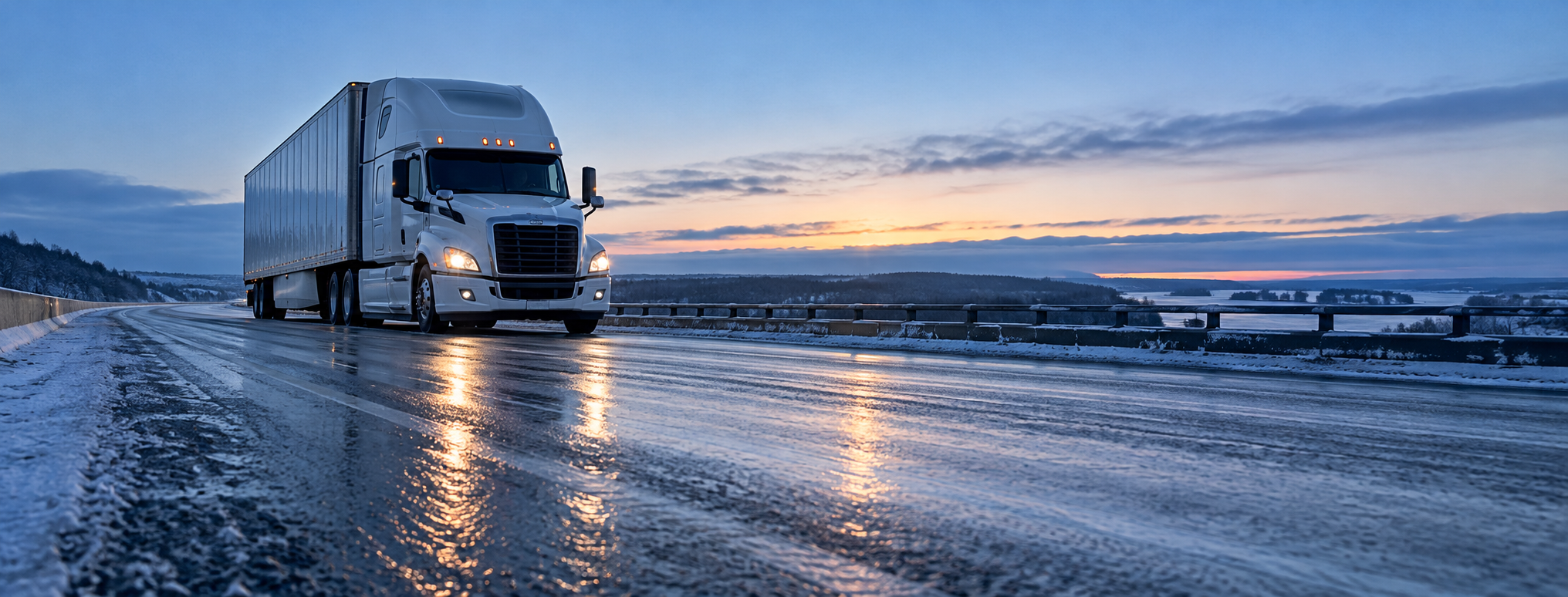
Which road is worse? You cannot know from the image alone. Road A may be more deceptive; Road B at least advertises the risk. Use surface temperature, recent moisture, road reports, location, and changing tire spray instead of appearance by itself.
Decide before departure
Winter driving starts with a go, delay, reroute, or stop decision. Check the forecast for the entire route, not only the origin and destination. Review state 511 or Department of Transportation road reports, chain requirements, closures, wind advisories, and the timing of freezing rain or snow squalls. Check again at safe stops because the plan that was reasonable at dispatch may no longer be reasonable several hours later.
Build an alternate route and a safe stopping option into the trip. Know where grades, bridges, exposed areas, and weather boundaries fall along the route. Leave room in the schedule for conditions to improve. Delivery pressure is never a reason to continue when the vehicle cannot be kept under control.
Make the pre-trip winter-specific
A normal inspection remains essential, but winter puts extra pressure on the systems that preserve control, visibility, and vehicle balance. Follow company procedure, the vehicle manual, and applicable regulations, then pay close attention to:
- Tires: inspect condition, inflation, tread depth, sidewalls, and anything lodged between duals. Cold temperatures can reduce tire pressure.
- Brakes and air system: check for air leaks, moisture, damaged lines, uneven adjustment, frozen components, and anything that could create an imbalanced response.
- Fifth wheel and connections: confirm the coupling, airlines, electrical line, and locking components are secure and free of packed snow or ice.
- Lights and reflective material: clean away snow, ice, salt, and road film so the entire unit remains visible.
- Windshield, mirrors, wipers, washer fluid, heater, and defroster: establish full visibility before moving and carry winter-rated washer fluid.
- Load securement: confirm the cargo is balanced and secured. A shifting load can make a low-traction event worse.
- Snow and ice removal: clear the cab, glass, lamps, steps, handholds, and other surfaces required by law and company policy before travel.
- Emergency readiness: carry required chains and traction equipment where applicable, warm clothing, gloves, a flashlight, food, water, medication, charging capability, and warning devices. Maintain enough fuel for delays and safe cab heat.
Read the conditions, not just the road
No single clue proves that black ice is present, but several together should change the operating decision:
- Near-freezing temperatures: the pavement can be colder than the air reading in the cab. Do not treat 33 or 34 degrees as an automatic all-clear.
- Recent rain, snowmelt, freezing rain, or freezing fog: each can leave moisture available to freeze.
- A wet-looking surface without expected tire spray: a sudden reduction in spray can mean the water has frozen. Treat the change as a warning.
- Frost on mirrors, signposts, antennas, or guardrails: exposed surfaces can reveal freezing conditions before the pavement is obvious.
- Bridges, ramps, shaded sections, low spots, and areas near water: expect the surface temperature to change quickly.
- Gloss, reflection, or an unusually dark lane: assume reduced traction until conditions are confirmed.
- Other traffic: vehicles moving unusually slowly, sliding, or making sudden corrections are evidence to create more space and reconsider continuing.
Never test the road with a sharp brake, steering, or throttle input. That turns a suspected hazard into an actual loss of control.
Operate for the traction you may not have
FMCSA emphasizes maintaining a speed that keeps the vehicle under control as weather and road conditions change. On snow or ice, legal speed can still be unsafe speed. Reduce speed before reaching the bridge, curve, ramp, downgrade, shaded stretch, or traffic queue. Trying to lose speed after entering the slick area consumes traction that may not be available.
- Create a large space cushion: stopping distance grows quickly as traction falls. Avoid following a fixed number of seconds as if it guarantees safety. Keep adding room until speed and spacing fit the actual surface.
- Use smooth inputs: brake, steer, accelerate, and shift gradually. Traction used for hard braking is not available for a sharp turn.
- Turn off cruise control: the driver needs direct control of power when traction can change without warning.
- Finish slowing before curves: enter at a speed that does not require braking or an abrupt correction in the curve.
- Respect grades: select a safe speed and gear before the descent. Avoid depending on a late brake application to control speed.
- Give plows room: stay well back where the operator can see you. Do not crowd or pass into the snow cloud unless directed and conditions clearly permit.
- Protect the lane: avoid unnecessary lane changes. If one is essential, make it slowly with ample space.
If the roadway is icy, the sound decision may be to stop. FHWA guidance for commercial operations says to reduce speed to a crawl and stop driving as soon as the vehicle can be safely moved off the roadway and away from skidding traffic. Choose a legal, stable location where another vehicle is unlikely to slide into the unit. Do not stop in a travel lane, on a bridge, or in a place that leaves the trailer exposed to traffic.
Understand the type of skid
A skid is not one single event, and one memorized reaction does not fit every vehicle or every loss of traction. These principles summarize the FMCSA Model Commercial Driver License Manual. They are a reminder, not a substitute for supervised training.
Drive-wheel acceleration skid
Too much power can cause the drive tires to spin sideways on a slick surface. Release the accelerator so the wheels can regain rolling traction. The FMCSA manual also discusses disengaging the clutch on very slippery surfaces so the wheels can roll freely. Drivers should apply the procedure taught for their specific transmission and company equipment.
Drive-wheel braking skid
When drive wheels lock during braking, the trailer can push the tractor sideways. Release the braking force that locked the wheels so they can roll again, then correct the steering carefully as traction returns. Counter-steering too slowly, too far, or too long can send the vehicle into a skid in the opposite direction.
Front-wheel skid
If the steer tires lose grip, the vehicle may continue straight even though the steering wheel is turned. Excessive speed is a common cause. Stop adding steering angle or hard braking and allow the vehicle to slow so the tires can regain traction.
ABS is not extra traction
Anti-lock brakes can help prevent wheel lock and preserve steering control during hard braking, but they do not make a slick surface safe and may not shorten the stop. Follow the braking procedure for the vehicle and company training. For an ABS-equipped vehicle during emergency braking, the FMCSA manual teaches firm brake pressure and says not to release the brakes just because ABS activates. Never pump ABS brakes.
The best skid recovery is prevention: a lower entry speed, more following distance, an early decision, and smooth control inputs. A webpage cannot reproduce hands-on skid-control training, and drivers should not practice recovery techniques on public roads.
Why jackknifes develop so quickly
A jackknife can begin when the tractor drive wheels lose traction and slide sideways while the trailer continues forward. It can also develop when trailer wheels lock and the trailer starts to swing. Speed, curves, downhill force, hard braking, abrupt steering, and an unbalanced or shifting load can magnify the motion.
Prevention depends on arriving at the hazard slowly enough to preserve traction. Brake before the curve or slick section, keep steering changes small, and avoid applying more power than the drive tires can transfer to the road. If the vehicle begins to fold, recovery actions must match the type of skid and the equipment. Follow formal training rather than improvising.
Other winter hazards that change the decision
- Freezing rain: can coat a large area faster than road treatment can keep up. A safe parking decision may be the only reliable control.
- Snow squalls and whiteouts: visibility and traction can collapse within seconds. Do not drive into a wall of snow at highway speed.
- Freezing fog: can create both poor visibility and a thin ice coating without ordinary rain or snow.
- Wind: crosswinds can move an empty or lightly loaded trailer, especially on open highways and bridges. Ice leaves less traction for correction.
- Snow-covered markings and shoulders: make it harder to judge lane position, road edge, ramp geometry, and safe pull-off areas.
- Road treatment: salt and chemicals can improve conditions, but a treated road is not a guarantee of traction. Temperature, traffic, precipitation rate, and time all affect the result.
After a slide or near miss
Once the unit is stable, find a safe place to stop. Take time to settle your attention before deciding whether to continue. A near miss is evidence that the surface, speed, spacing, or route no longer provides the expected margin.
Perform an inspection consistent with company procedure. Check tires and wheels, brake components, air and electrical lines, the fifth wheel and trailer connection, lights, body damage, and load securement. If the unit contacted a curb, shoulder, object, or severe pothole, do not assume it is roadworthy because it still moves.
Report the incident or near miss through the proper channel and document the location and conditions when it is safe to do so. A professional safety culture learns from conditions that almost became crashes, not only from the events that did.
Black ice quick-reference checklist
- Before the trip: check the entire-route forecast, road reports, closures, chain rules, alternate routes, fuel, emergency supplies, and a winter-focused pre-trip.
- Before the hazard: turn off cruise control, reduce speed early, increase space, and finish braking before bridges, curves, ramps, grades, and shaded areas.
- If the road looks wet near freezing: assume ice is possible. Watch for missing tire spray, frost on roadside surfaces, gloss, and changing behavior from other traffic.
- If traction changes: stay calm, ease off the accelerator, look where you need to go, and avoid abrupt inputs. Use the trained response for the skid type and equipment.
- If control cannot be assured: slow to a crawl and move off the roadway at the first safe, legal location. Wait for conditions to improve.
- After a slide: stop safely, inspect the unit and load, report the event, and reassess the plan before continuing.
Sources and additional reading
- National Weather Service: Ice and black ice
- National Weather Service: Winter driving
- National Weather Service: Getting traction
- FMCSA: Model Commercial Driver License Manual
- FMCSA: Safe speed for commercial motor vehicles
- FHWA: Driver safety issues in adverse conditions
- We Will Transport It: Black ice and trucks, the original guide that inspired this expanded article.
This article is general safety information, not a substitute for company policy, formal driver training, the current CDL manual for the driver’s licensing state, applicable law, real-time instructions from authorities, or the operating guidance for a specific vehicle.